
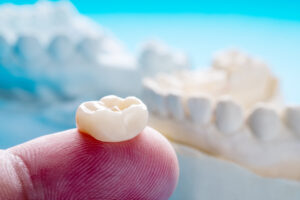
Have you ever wondered how your dentist chooses the perfect shade for a dental crown so it blends in with the rest of your teeth? It’s a lot more involved than holding up a color swatch. Here’s a brief look at the science, and a little bit of art, behind the process.
Why Tooth Color Is So Complicated
Your teeth aren’t one flat color. Enamel is slightly translucent, and the warmer dentin underneath shows through it, so every tooth shifts in tone from the gumline to the edge. Dentists evaluate three qualities: hue (the basic color family, like yellowish or grayish), chroma (how intense that color is), and value (how light or dark it looks). Age plays a role, too. As enamel thins over the years, more yellowish dentin becomes visible.
Step One: The Shade Guide
The classic tool is a shade guide, a set of tooth-shaped tabs organized by color family and numbered by intensity and brightness. Your dentist holds the tabs next to your tooth to find the closest match, usually choosing the main body shade first and then fine-tuning the area near the gums and the edge so the transitions look natural.
Technique matters, too. Shade selection is best done early in your appointment, before teeth dry out and look lighter, using natural or neutral lighting and quick glances to avoid tired eyes.
Step Two: Technology Weighs In
Some dentists also use a spectrometer, a small device with sensors that measures the light reflected by your tooth and gives a more objective reading, which is especially helpful when your tooth falls between two shades. Your dentist will typically take photos as well, noting details like translucency and subtle surface characteristics.
Step Three: The Lab Brings It to Life
All of that information goes to a dental lab, where a skilled ceramist builds your crown by layering and firing ceramic to recreate the color, translucency, and natural sheen of enamel. The shade of the prepared tooth underneath matters, too, because translucent materials can let it show through, so your dentist records that information as well. Many dentists also show you the chosen shade in a mirror so you can weigh in.
It’s Not Just About Color
A crown can be the right shade and still look fake if it’s too opaque or too shiny. Real enamel lets some light pass through, which is why porcelain is so popular. Your dentist and lab also shape and polish the crown to match your neighboring teeth, so it doesn’t stand out under any lighting.
How You Can Help Get a Perfect Match
If you’re thinking about whitening your teeth, do it before your crown is made, since crowns don’t change color with whitening treatments. On the day your shade is chosen, skip bold lipstick and bright clothing, which can throw off color perception. Neutral gray is ideal. Most importantly, speak up about what you see and prefer.
About the Practice
Beau A. Deaver, DDS, MS, in Dallas, TX, is led by Dr. Beau Deaver, a prosthodontist who earned his DDS from the UT Health San Antonio School of Dentistry and completed his prosthodontic residency at the Texas A&M University College of Dentistry. He takes a conservative approach and designs custom, lifelike restorations, including all-ceramic crowns. To schedule a consultation, call (214) 750-6106 or contact us today.